
Blue-green Algae Bloom Update
- Seymour_Lake_SLCS Website
- Sep 20, 2025
- 7 min read

Updated: Dec 26, 2025
Update from Dec. 24, 2025
We recently reached out to Northern Health to ask them to let us know about when they will be rescinding the "Do Not Consume" water advisory that they placed on the community water system in the Fall due to the Algae Bloom.
Raquel Schoeneberg, the Environmental Health Officer wrote back to say the following:
"After discussing with my Team Lead Shane Wadden and David Creighton (the Drinking Water Specialist – EHO in prior email correspondences), we have reached the time that we can be very sure based on normal biological processes that the concentration of cyanobacteria toxins has reduced below levels of concern. We are prepared the rescind the Do Not Consume notice for the community water system and the caution for the water users."
Update from Nov. 21, 2025
The bloom this year is less extensive than last year but still significant. Last year, the bloom was present up until the lake froze over. Blue-green algae needs light to grow. As snow settles and builds up on the ice, it blocks the light and the blue-green algae dies. This is beginning to happen now.
While it is good news that the blue-green algae is showing signs of dying, the potential danger to water users is not over yet. The organisms can release toxins as they die. The do not consume notice that Northern Health has placed on the Seymour Lake Water Users Community (who draw water from the south end of Seymour Lake) is still in place at this time.


Update from Nov. 14, 2025

The lake continues to produce blue-green algae. The areas of concentration have varied day to day depending on the amount and direction of the wind.
As of November 14, 2025, the size of the blue-green algae bloom that is happening on Seymour Lake has decreased from the last time that we mapped it (Friday Nov. 7). We canoed around the lake today to map out all the spots where algae is visibly present (see map and key above).
The highest concentration of blue-green algae is found in the northeastern corner of Seymour Lake. In that corner, the blue-green algae is an 9 on our scale. The high concentration of blue-green algae does not extend out into the water at the north end of the lake as much as it did on Nov. 7, when we last mapped it. Much of the blue-green algae in the northeast corner is trapped in the thin layer of ice that has formed around the edges of the lake.
The wind has pushed some of the blue-green algae from the north shore, toward the eastern shore. On the eastern shore, along Seymour Lake Road, the blue-green algae has increased in concentration.
In the southeastern section of Seymour Lake the amount of blue-green algae has decreased since Nov. 7. At the southern end of the lake, there is very little or no visible blue-green algae, except at the southwest corner of the lake, where there is a small patch of algae that we classified as level 5.
Overall, the level of blue-green algae has decreased on the western side of the lake.
Update from Nov. 7, 2025

As of November 7, 2025, the size of the blue-green algae bloom that is happening on Seymour Lake has increased a little from the last time that we mapped it (Sunday Nov. 2). We canoed around the lake today to map out all the spots where algae is visibly present (see map and key below).
The highest concentration of blue-green algae is found in the northeastern corner of Seymour Lake. In that corner, the blue-green algae is a 10 on our scale (see photos below). Since last Sunday, the blue-green algae on the eastern side of the lake has increased in concentration. At the southern end of the lake, there is still very little visible algae.
Here is what David Creighton, our contact at Northern Health, said (on Nov. 6, 2025) about the level of risk posed by the blue-green algae bloom to humans who consume the Seymour Lake water:
If the toxins are created, they are released slowly when the bacteria is alive and when the bacteria die, the toxins are released from the cells. The end of the bloom would represent the highest concentration of toxins and therefore the greatest risk. As the toxins degrade or dissipate through the lake the concentration will decrease, and the risk will decrease as well. So, without extensive testing it is difficult to assess the risk but following the general lifespan of algae we can predict risk.
We generally don’t like to use absolutes when we deal with risks so I would say there is a minimal risk if the drinking water intake is not in the location of the bloom. For safety, I would refer back to treatment, including filtration including granulated activated carbon filters. With proper treatment I would say that it is safe to drink.

For the residents who draw water from the northern part of the lake and the Seymour Lake Water Users Community, there is an elevated level of risk because this is where the concentration of blue-green algae is the highest. David Creighton has issued a Do Not Consume Notice for the Seymour Lake Water Users system. He recommends that "it would be good for the rest of the residences on the lake to do the same if the bloom is near their drinking water intake."
If you experience an illness that you feel may be related to drinking the water (stomach problems) or having the water come into contact with your skin (skin irritation), then please let us know (president.seymourlakecs@gmail.com) or contact Northern Health directly. We would also like to know if you have a pet who falls ill or if you observe dead waterfowl/animals in the lake around the bloom.
Update from Nov. 2, 2025

As of November 2, 2025, the blue-green algae bloom on Seymour Lake has decreased significantly from the last time that we mapped it (Oct. 28). We canoed around the lake today to map out all the spots where algae is visibly present (see map and key on left).
If you experience an illness that you feel may be related to drinking or coming into contact the water, then please let us know by emailing us at president.seymourlakecs@gmail.com or by contacting Northern Health directly. We would also like to know if you have a pet who falls ill or if you observe dead waterfowl/animals in the lake around the bloom.
Update from Oct. 28, 2025

As of Oct. 28, 2025, there is a significant algae bloom happening on Seymour Lake. We canoed around the whole lake today to map out all the spots where algae is visibly present (see map and key on left).
Today, we will file a report with Algae Watch and alert Northern Health to the situation. If you draw water directly from Seymour Lake, you may want to consider using bottled water for drinking until the algae bloom decreases. Boiling water does not remove the toxins produced by blue-green algae.
Update from Oct. 20, 2025
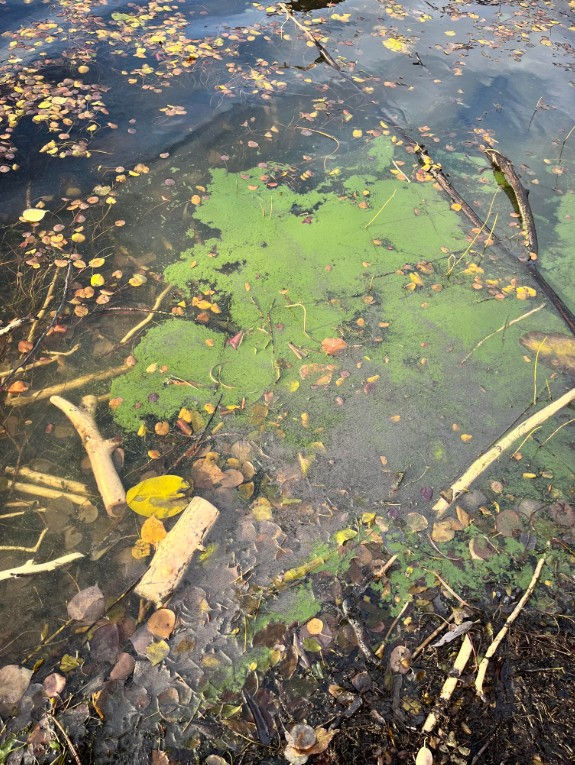
As of Oct. 20, 2025, there is little visible blue-green algae on Seymour Lake. On most of the lake, the amount of algae looks similar to the photo that we took on Sept. 11 (see below). However, there a very small patch of brightly coloured algae that is present close to the shore along Seymour Lake Road. Here is a picture of how it looks. Other than the usual "Boil Water" notice, that are currently no other special restrictions on Seymour Lake water at this time.
Update from Oct. 14, 2025
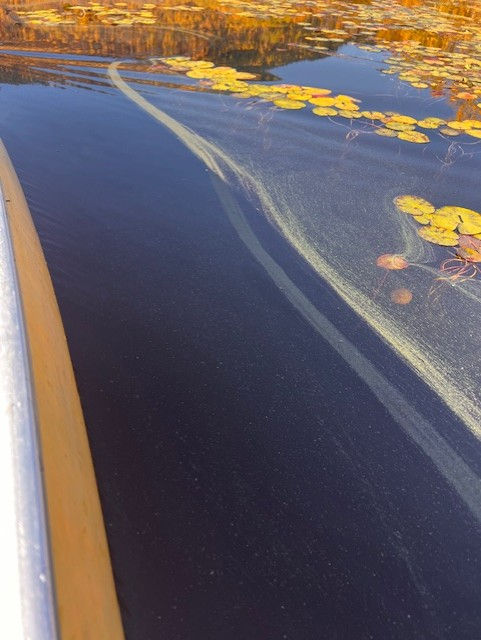

As of Oct. 14, 2025, there is a small amount of visible algae present on Seymour Lake. The photo on the left shows an area close to the northwest shore, where the algae clumped together to make long lines in the water. The photo on the right shows the same place on the northwest shore, but it is showing the patch where the algae was thickest. The algae patch was scattered around an area of roughly 3m by 6 m.
Update from Oct. 8, 2025
As of Oct. 8, 2025, it appears that the small algae bloom is no longer visible on the surface of Seymour Lake.
Update from Sept. 19, 2025
As of Sept. 19, 2025, it appears that there is a very small algae bloom on Seymour Lake. The amount of algae that is visible is too small for us to log a report on Algae Watch.
Update from Sept. 11, 2025

As of Sept. 11, 2025, it appears that the small algae bloom is no longer visible on the surface of Seymour Lake. Other than the usual "Boil Water" notice, there are currently no other special restrictions on Seymour Lake water at this time.
Update from Sept. 4, 2025

On Sept. 4, 2025, there was a small amount of algae that began to bloom on Seymour Lake. We notified Northern Health about it and we monitored its growth. We did not test it to see if it it blue green algae or not. We reported our findings to Algae Watch, but they said that the bloom is too small to justify a report on it. Other than the usual "Boil Water" notice, that are currently no other special restrictions on Seymour Lake water at this time.
History of the Blue Green Algae Bloom on Seymour Lake
Fall of 2024

In the Fall of 2024, Seymour Lake experienced a large blue green algae bloom. It posed a significant health risk so Northern Health put a "A Do Not Use Water" advisory into effect. The bloom died off over the winter. The photo on the left shows the blue-green algae levels that we mapped on Seymour Lake on October 30, 2024.
Three SLCS members tested the water in the Spring of 2025 and all three test results confirmed that the algae bloom was gone. As a result, the Northern Health downgraded the advisory to a "Boil Water" notice, which has remained in place since that time.


Comments